
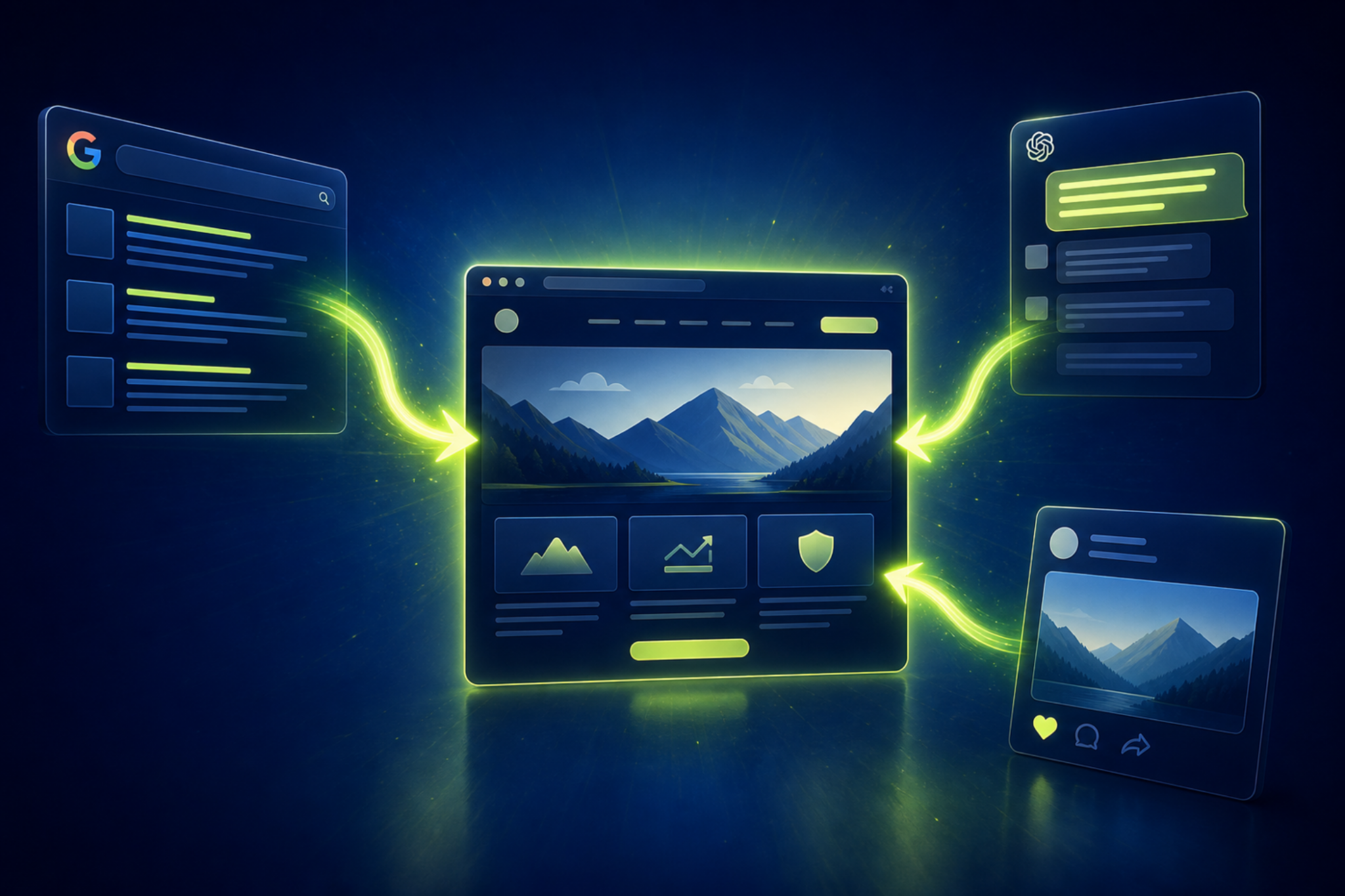

Do you want to drive more website traffic in 2026? That requires a strategy that works across two distinct discovery systems: traditional search engines like Google, and AI-powered answer engines like ChatGPT, Perplexity, and Google AI Overviews. These systems reward overlapping but not identical signals, and businesses that optimize for both consistently outperform those that focus on one at the expense of the other. This post covers the practical steps that build traffic from both channels: starting with the technical foundation they share, then the content architecture that earns citations and rankings, and finally the distribution and paid strategies that accelerate what organic search builds slowly.
Is your website showing up in AI answers and Google search?
We help local businesses build the content and technical foundation that drives traffic from both traditional search and AI engines.
The Quick Take: Traditional SEO vs. AI Search Visibility
| Traditional SEO | AI Search (AEO) |
|---|---|
| Optimizes for ranking positions on a results page | Optimizes for citation inside an AI-generated answer |
| Success measured by rank, impressions, and clicks | Success measured by citation frequency and referral visits from AI platforms |
| Rewards keyword relevance, backlinks, and technical health | Rewards direct answers, structured content, and schema markup |
| Content written for human readers scanning a results page | Content written for AI retrieval systems extracting specific answers |
| Results build over months as authority accumulates | Citations can appear within days of publishing well-structured content |
The Takeaway: SEO and AEO are not competing strategies. The content structure that earns AI citations (direct answers, clear headings, FAQ schema) also improves traditional search rankings. Investing in one strengthens the other.
💡 Pro Tip: The fastest way to assess your current traffic mix is to open Google Analytics 4, go to Acquisition, then Traffic Acquisition, and look for referral sessions from domains like chatgpt.com, perplexity.ai, and gemini.google.com. If you see zero traffic from those sources, your content is not yet optimized for AI citation. That gap is fixable with structural content changes and schema markup.
Table of Contents
→ Build the Technical Foundation Both Systems Require
→ Structure Content to Earn AI Citations
→ Apply the SEO Fundamentals That Still Drive Organic Traffic
→ Use Schema Markup to Signal Your Content to AI Engines
→ Distribute Content Where AI Engines Look for Authority Signals
→ Use Paid Advertising to Accelerate What Organic Builds Slowly
→ The Bottom Line on Driving More Website Traffic
→ FAQ: Common Questions
Build the Technical Foundation Both Systems Require
Site speed, mobile performance, and crawlability are table stakes for both traditional search rankings and AI citation. A page that loads slowly, renders poorly on mobile, or blocks crawlers cannot rank well in Google and will not be retrieved by AI engines regardless of how well the content is written. Technical problems are the most common reason a well-written page fails to generate traffic from either source.
Page speed is the most impactful technical variable for most small business websites. The two most useful tools for diagnosing speed issues are Google PageSpeed Insights and GTmetrix, both of which are free and provide specific, actionable recommendations. The most common fixes are compressing images before uploading, reducing the number of third-party plugins, and ensuring your hosting environment is adequate for your traffic volume. On WordPress specifically, image compression and caching plugins resolve the majority of speed issues without requiring developer involvement.
Mobile performance matters independently of speed. Google indexes the mobile version of your site first, which means a page that looks fine on desktop but breaks on a phone is being evaluated primarily in its broken state. Check every page you publish on a real phone before considering it live. The visual check takes 30 seconds and catches layout problems that automated tools miss.
💡 Pro Tip: AI crawlers are less tolerant of technical errors than Google’s crawler, which has years of context about your site. A page with broken internal links, missing canonical tags, or a disorganized heading structure may still rank in Google on the strength of historical authority. That same page may be skipped entirely by an AI retrieval system that has no prior relationship with your domain. Fix technical issues as a prerequisite for AEO work, not as an afterthought.
Structure Content to Earn AI Citations
AI engines like ChatGPT, Perplexity, and Google AI Overviews do not read your content the way a human does. They run retrieval systems that scan for the passage most likely to answer a specific query, extract it, and surface it as a citation in the AI’s response. Content that buries its answer three paragraphs into a section, or that covers multiple concepts in a single dense paragraph, is routinely skipped in favor of a cleaner source that answered the same question more directly.
The structural changes that make content citable are straightforward. Write every section heading as a question or a direct statement that mirrors how someone would search for that information. Open every section with the answer in the first sentence rather than building toward it. Keep paragraphs to two to four sentences covering one idea each. These are the same structural principles that improve human readability, which is why AEO-optimized content tends to reduce bounce rate and improve time on page as a side effect.
Content depth and topical consistency signal authority to both Google and AI engines. A website that covers a narrow topic in depth earns more citations than a broad site that touches many topics shallowly. For local businesses, this means creating a cluster of pages around your core service area rather than writing isolated posts about loosely related topics. Each page in a cluster should link to the others, creating a navigable topic structure that both human readers and AI retrieval systems can follow. For a detailed walkthrough of how to structure content for AI citation specifically, the AEO schema guide covers the full framework.
Apply the SEO Fundamentals That Still Drive Organic Traffic
Traditional SEO fundamentals have not been replaced by AI search. They have become the prerequisite for it. Google still drives the majority of organic web traffic, and the signals it uses to rank pages (topical authority, inbound links, page experience, and keyword relevance) remain as important as they have always been. The businesses most likely to earn AI citations are also the ones most likely to rank well in traditional search, because both systems reward the same underlying quality signals.
Long-tail keywords remain one of the highest-leverage SEO tactics for local businesses competing against larger, more established sites. A local plumber will not rank for “plumber” but can rank for “emergency pipe repair Oceanside no weekend surcharge” because the competition for that specific phrase is far lower and the intent is far more specific. Descriptive, conversational phrases that mirror how your customer actually speaks are also the exact phrases AI engines retrieve answers for, which makes long-tail keyword research doubly valuable in 2026.
Internal linking is consistently underused by small business websites and consistently rewarded by Google. Every page you publish should link to at least two other relevant pages on your site, and your highest-value pages should receive links from multiple other pages. This creates a navigable authority structure that distributes ranking signals across your site rather than concentrating them on your homepage. It also makes it easier for AI crawlers to understand how your content is organized and which pages cover which topics most authoritatively.
Use Schema Markup to Signal Your Content to AI Engines
Schema markup is structured data added to your page’s HTML that tells both AI crawlers and Google what your content means, not just what it says. A page about your business hours that uses LocalBusiness schema communicates that information in a machine-readable format that AI engines can extract and cite with confidence. The same information written in plain text requires the AI to infer meaning from context, which is less reliable and less likely to be cited.
For local businesses, three schema types produce the most direct traffic impact. FAQPage schema maps your questions and answers to specific query patterns, making your FAQ content easy to retrieve and cite. Article schema with explicit author, dateModified, and publisher fields signals recency and authority. LocalBusiness schema with accurate address, hours, and service area information gives AI engines a verified data point to cite when users ask location-specific questions. Adding these three schema types to your key pages is the highest-leverage technical AEO action available to a local business website.
On WordPress, plugins like RankMath Pro handle FAQPage and Article schema generation without requiring code. The critical requirement is consistency. Schema that contradicts your visible page content, with outdated hours or a mismatched address, actively reduces your citation likelihood rather than improving it. Verify your schema is accurate every time you update a page it appears on.
Distribute Content Where AI Engines Look for Authority Signals
AI engines build their understanding of which sources are trustworthy partly from how those sources appear across the broader web. A business mentioned consistently on third-party platforms, cited in forum discussions, and linked from authoritative industry sites carries more citation weight than a business that exists only on its own domain. Distribution is not just about driving direct referral traffic. It is about building the off-site authority signals that AI engines use to decide whether your content is worth citing.
For local businesses, the most impactful distribution channels are Google Business Profile, which feeds directly into Google’s AI Overviews for local queries; industry-specific directories and review platforms that create consistent name, address, and phone mentions; and community platforms like Reddit and Quora where AI engines actively look for real-world opinion and expertise. Publishing useful, non-promotional answers on Quora in your area of expertise creates citation signals that compound over time as AI engines index those responses alongside your website content.
Social media distribution accelerates indexing and builds brand entity recognition. When your business name and content appear consistently across platforms, AI engines develop a stronger entity signal around your brand, which increases the likelihood that your site is cited when a user asks a question relevant to your expertise. This is a secondary traffic mechanism rather than a primary one, but it reinforces everything else you are doing on-site. For more on how AI engines use off-site signals to determine citation authority, the guide to getting cited by answer engines covers the full picture.
Use Paid Advertising to Accelerate What Organic Builds Slowly
Organic search and AI citation both build authority over time, but paid advertising produces traffic on a timeline you control. For local businesses that need customers now rather than in six months, paid social and paid search are not alternatives to the organic strategies above. They are a parallel channel that generates measurable results while the longer-term authority signals accumulate.
Paid search captures intent that already exists. Someone who types “roof repair Oceanside” into Google is actively looking for a provider. A well-structured Google Search ad puts your business in front of that person at the exact moment they are making a decision. Paid social builds awareness with people who have not started searching yet. It is an earlier stage of the funnel that plants your brand in the mind of a potential customer before they need you.
The combination that works best for most local businesses is organic content and AEO for long-term authority building, and paid search for high-intent local queries where budget allows immediate visibility. Paid social accelerates brand recognition and can drive direct conversions for the right offer and audience. None of these channels replaces the others. Each serves a different moment in the customer’s journey toward hiring you.
The Bottom Line on Driving More Website Traffic
Driving more website traffic in 2026 means building a presence that shows up in the places people actually look for answers: Google search results, AI-generated responses, and the community platforms that AI engines use to validate authority. The businesses that grow their traffic most consistently are the ones that treat SEO and AEO as a single integrated strategy rather than separate projects.
The technical foundation (fast load times, mobile performance, clean crawlability) is the prerequisite for everything else. The content structure (direct answers, question-based headings, focused topic clusters) earns both traditional rankings and AI citations. The schema markup layer communicates your content’s meaning to machines. The distribution work builds the off-site authority that both Google and AI engines use to decide whether you are worth citing.
Start by auditing one high-traffic page for AEO structure: does it open with a direct answer, use question-based H2 headings, and include FAQ schema? Fix those three things on your best-performing pages before publishing anything new. The improvement in both search rankings and AI citations from that structural work will tell you exactly how much opportunity is sitting in your existing content.
🎯 Want More Traffic From Both Google and AI Search?
We help local businesses build the content structure, schema markup, and technical foundation that earns traffic from traditional search and AI citation simultaneously. Book a free 15-minute call to find out where your site stands.
→ Book a Free SEO and AEO Audit
15 minutes. No pitch. Just a clear picture of what your site needs to perform.
Frequently Asked Questions About Driving More Website Traffic
What is the fastest way to drive more website traffic?
The fastest way to drive more website traffic is paid search advertising, which puts your site in front of people actively searching for what you offer immediately after launch. For sustainable long-term traffic, the highest-leverage organic action is auditing your existing high-impression pages in Google Search Console and updating their structure for direct answers, question-based headings, and FAQ schema. These structural improvements can improve both traditional rankings and AI citations within weeks.
What is the difference between SEO and AEO for website traffic?
SEO optimizes your content to rank on a traditional search results page where users see a list of links and click through to your site. AEO (Answer Engine Optimization) optimizes your content to be cited inside an AI-generated answer on platforms like ChatGPT, Perplexity, and Google AI Overviews. Both channels drive website traffic, but through different mechanisms. The content structure that earns AI citations also improves traditional search rankings, so the two strategies reinforce each other.
How do I get my website cited by AI engines like ChatGPT and Perplexity?
Structure your content so each section opens with a direct answer to a specific question, use H2 headings that mirror how people phrase their queries, keep paragraphs to two to four sentences covering one idea each, and add FAQPage schema to your key pages. AI retrieval systems look for content that answers a specific question cleanly and extractably. The more precisely your content answers a specific question, the more likely it is to be retrieved and cited.
Does site speed affect website traffic?
Yes. Site speed is a confirmed Google ranking factor and affects how AI crawlers evaluate your pages. Slow pages rank lower in search results and are more likely to be skipped by AI retrieval systems. Free tools like Google PageSpeed Insights and GTmetrix identify the specific issues slowing your site. The most common fixes are image compression, reducing plugin count, and upgrading hosting.
What are long-tail keywords and why do they matter for small businesses?
Long-tail keywords are specific, conversational phrases that describe a narrow topic or intent rather than a broad category. Small businesses rarely rank for broad terms because established competitors dominate those rankings. Long-tail keywords have lower competition and higher conversion intent, and they also match the conversational phrasing that AI engines retrieve answers for, making them doubly valuable for traffic generation in 2026.
What schema markup should a local business add to drive more traffic?
Three schema types produce the most direct traffic impact for local businesses: FAQPage schema, which maps your questions and answers to specific query patterns; Article schema with author, dateModified, and publisher fields to signal recency and authority; and LocalBusiness schema with accurate address, hours, and service area to give AI engines a verified data point for location-specific queries. On WordPress, RankMath Pro handles all three without requiring code.
Should I use paid advertising to drive website traffic?
Paid advertising is the fastest way to drive immediate website traffic and works well alongside organic and AEO strategies rather than instead of them. Paid search captures intent that already exists. Paid social builds awareness with people who have not started searching yet. Organic content and AEO build long-term authority. Each channel serves a different moment in the customer journey, and the strongest local marketing strategies use all three.
How long does it take to see results from SEO and AEO?
AI citation can appear within days of publishing well-structured content on a credible domain, particularly on platforms like Perplexity that perform real-time web retrieval on every query. Traditional SEO results typically take longer: weeks to months depending on your domain authority, competition, and how frequently Google recrawls your site. Structural improvements to existing high-impression pages often produce faster results than publishing new content because the pages already have some search visibility.
Social media drives direct referral traffic when followers click links to your content, and it builds indirect traffic benefits by strengthening your brand’s entity signals across the web, which AI engines use to evaluate citation authority. Social media is a secondary traffic driver rather than a primary one for most local businesses, but it reinforces organic and AI search strategies meaningfully.
What is the most important thing I can do right now to drive more website traffic?
Audit one of your highest-impression pages in Google Search Console and update it for AEO structure: rewrite the headings as questions, make sure each section opens with a direct answer, and add FAQPage schema. This single action improves both traditional search performance and AI citation likelihood on a page that already has some search visibility. The improvement is measurable within weeks and tells you how much traffic opportunity is sitting in your existing content.