

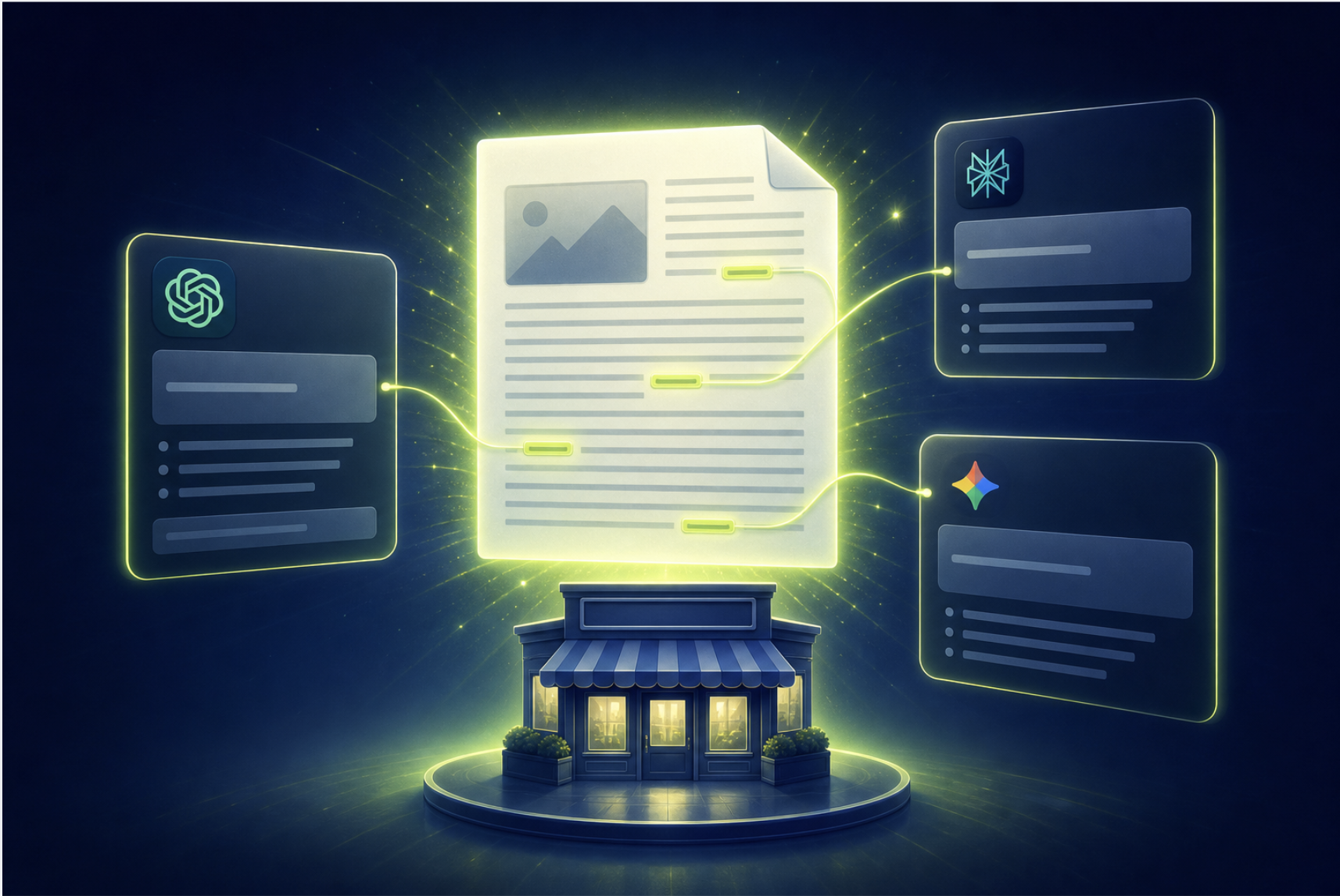

Getting cited by answer engines comes down to one thing: writing content that AI systems can extract, verify, and repeat with confidence. ChatGPT, Perplexity, and Google AI Overviews don’t cite randomly. They favor sources that answer specific questions directly, carry structured markup, and have enough authority signals for the model to trust the claim. This post breaks down exactly how that citation process works and what you need to do to show up consistently.
Is your business showing up in AI answers?
AEO services built for local businesses that want to be cited by the tools their customers actually use.
The Quick Take: Old SEO vs. Answer Engine Optimization
| Traditional SEO | Answer Engine Optimization (AEO) |
|---|---|
| Rank on page one of Google | Get cited inside AI-generated answers |
| Optimize for keyword density and backlinks | Optimize for question-answer structure and schema |
| Click-through rate is the primary success metric | Citation frequency and source attribution matter most |
| Content written for human readers scanning a SERP | Content written for AI models extracting direct answers |
| Success measured in rankings | Success measured in AI mentions and referral visits |
The Takeaway: Getting cited by answer engines requires a different content architecture than traditional SEO — but the two strategies reinforce each other when done correctly.
💡 Pro Tip: You do not have to choose between ranking on Google and getting cited by AI engines. Pages with clean heading structure, direct answers, and FAQ schema tend to perform well in both environments. Build for citation first, and traditional SEO benefits follow.
Table of Contents
→ How Answer Engine Citation Actually Works
→ How ChatGPT, Perplexity, and Google AI Overviews Cite Differently
→ What Content Structure Gets You Cited
→ How Schema Markup Signals Your Content to AI Models
→ How to Test Whether You Are Already Cited by Answer Engines
→ How to Track Citation Traffic in GA4
→ The Bottom Line on Getting Cited by Answer Engines
→ FAQ: Common Questions
How Answer Engine Citation Actually Works
Answer engines cite sources for the same reason academic papers do: to establish that a claim has an origin outside the model itself. When a user asks ChatGPT or Perplexity a question, the model retrieves content from across the web, synthesizes it into a coherent answer, and attaches citations to the passages it used. Your content gets cited when the model determines it contains a clear, extractable answer to the query being processed.
The retrieval process favors content that matches three conditions. First, the content must directly answer the question rather than introduce it. Second, the page must be technically accessible — crawlable, fast-loading, and not blocked by login walls or aggressive bot filtering. Third, the source must carry enough authority signals for the model to treat it as credible. Authority here means a combination of inbound links, brand mentions across the web, schema markup, and consistent topical focus.
One important distinction: not all AI citations link back. Some engines mention your business or content in the body of the answer without a clickable footnote. These still matter. Named mentions build the model’s internal sense of your brand as a trusted entity, which increases the likelihood you get cited again in future queries on the same topic.
💡 Pro Tip: AI models build an implicit “trust map” of sources over repeated crawls. A site that consistently covers a narrow topic in depth earns higher citation frequency than a broad site with thin coverage of many topics. Depth beats breadth every time for AEO.
How ChatGPT, Perplexity, and Google AI Overviews Cite Differently
Each major answer engine has a different citation philosophy. Understanding the differences helps you prioritize where to focus your optimization effort. Perplexity cites most aggressively, pulling sources for nearly every factual claim and displaying them as numbered footnotes. ChatGPT with browsing enabled cites less frequently but favors pages with explicit structured data and clear authorship. Google AI Overviews prioritize content already ranking well in organic search and weight E-E-A-T signals heavily.
| Platform | Citation Behavior |
|---|---|
| Perplexity | Heavy citation, numbered footnotes per claim, real-time web retrieval on every query |
| ChatGPT (browsing) | Selective citation, favors pages with structured content and clear author credentials |
| Google AI Overviews | Tightly tied to organic rankings; E-E-A-T signals and schema markup carry strong weight |
| Gemini | Blends Google Search index with its own knowledge base; favors well-indexed, fresh content |
💡 Pro Tip: Perplexity is often the fastest platform to earn your first citation because it retrieves sources on every query rather than relying on a pre-trained knowledge base. If you are testing your visibility, start there. Ask a question your ideal customer would ask and see whether your site appears in the footnotes.
What Content Structure Gets You Cited
AI engines extract answers from content that answers questions explicitly and immediately. That means the answer must appear in the first sentence of a section, not three paragraphs in after background context. This is called “answer-first” writing, and it is the single most impactful structural change you can make to an existing post.
Beyond the opening sentence, section headings matter enormously. Headings phrased as questions tell the retrieval system exactly what query the section answers. A heading like “What is FAQ schema?” maps directly to the query a user typed. A heading like “Schema Overview” tells the model nothing about the question being addressed. Rewrite every H2 as a question or a direct declarative statement, and your citation rate improves across all platforms.
Paragraph length is also a signal. AI engines parse and reproduce shorter, cleaner sentences more reliably than long compound constructions. Paragraphs capped at 3 to 4 sentences extract cleanly. Longer dense paragraphs often get skipped in favor of a competing source that said the same thing in fewer words.
For local businesses, this means updating your existing service pages and blog posts to follow this structure — not just new content. Answer engine schema setup is covered in detail in our AEO schema guide if you want a technical starting point alongside content structure.
How Schema Markup Signals Your Content to AI Models
Schema markup is structured data you add to your page’s HTML that tells AI crawlers — not just Google — what your content means, not just what it says. A block of text that reads “We are open Monday through Friday, 9 to 5” is readable by a human. The same information wrapped in LocalBusiness schema with explicit openingHours properties is machine-readable and citable.
For answer engine citation specifically, two schema types carry the most weight. FAQPage schema maps your questions and answers directly to query patterns, making it easy for an engine to pull your FAQ answer as a citation. Article schema with explicit author, dateModified, and publisher fields signals recency and authority — two factors every major answer engine weights in its retrieval algorithm.
Adding schema does not require a developer. Plugins like RankMath Pro handle FAQPage and Article schema generation without touching code. The key is consistency: schema that contradicts your visible page content (different business name, outdated address, mismatched hours) can actively reduce your citation likelihood rather than improve it.
💡 Pro Tip: LocalBusiness schema is underused by local service businesses and underweighted in most AEO guides. If you serve a specific city or region, adding LocalBusiness schema with your service area, business type, and contact information gives answer engines a structured data point to cite when users ask “who provides [service] in [city].”
How to Test Whether You Are Already Cited by Answer Engines
You can test your current citation status in under ten minutes by querying the major platforms directly. Open Perplexity, ChatGPT, or Google and type a question your ideal customer would ask about your service category or local area. Look for three citation signals in the response: numbered footnotes linking to your domain, your business name mentioned by name in the answer text, and your URL appearing in the source cards or reference list on the side of the response.
Use a mix of query types when testing. Brand authority prompts like “Who are the top [your service] providers in [your city]?” test whether the model recognizes your business as a named entity. Information authority prompts like “How do I [specific task you handle]?” test whether your content appears as a factual source. The results will tell you whether you have a visibility gap, a content gap, or a schema gap.
A few practical test queries for local service businesses:
- “Who provides [your service] in [your city]?”
- “What should I look for when hiring a [your business type]?”
- “How much does [your service] typically cost in [your region]?”
- “What is the best [your service category] option for [specific customer situation]?”
If you do not appear in any of those results, the gap is almost always one of three things: thin content that does not answer the question directly, missing schema markup, or insufficient inbound signals for the model to treat your site as authoritative. Our AEO schema guide walks through how to address all three systematically.
How to Track Citation Traffic in GA4
AI citation traffic shows up in GA4, but you have to know where to look. Open GA4, navigate to Reports, then Acquisition, then Traffic Acquisition. Filter the Session Source dimension for domains associated with AI platforms: chatgpt.com, openai.com, perplexity.ai, and gemini.google.com. Any sessions from these sources represent users who clicked a citation link inside an AI answer and landed on your site.
Not all AI citation traffic carries a referral label. Some sessions appear as Direct traffic because the AI interface does not pass a referrer header when a user clicks a citation. Sudden spikes in direct traffic to a specific deep blog post — not your homepage — are a reliable indicator of AI citation activity. The model cited that page, users clicked to verify, and the session registered as direct.
| What You See in GA4 | What It Likely Means |
|---|---|
| Referral from chatgpt.com or openai.com | Confirmed citation click from ChatGPT with browsing |
| Referral from perplexity.ai | Confirmed citation click from a Perplexity footnote |
| Spike in direct traffic to a deep blog post | Likely AI citation where no referrer header was passed |
| High impressions, low CTR in Search Console | Google AI Overview is showing your content; users are not clicking through |
💡 Pro Tip: For a more detailed setup guide on building AI traffic segments in GA4, The Digital Maze has a solid walkthrough covering custom channel groupings and regex filters. Worth bookmarking once you have confirmed citation traffic worth measuring.
The Bottom Line on Getting Cited by Answer Engines
Being cited by answer engines is not a content volume game — it is a content precision game. The businesses that earn consistent citations are not publishing more than everyone else. They are publishing content that answers specific questions directly, carries the structured markup that tells AI crawlers exactly what each page is about, and builds enough topical authority for the model to treat them as a reliable source worth repeating.
For local businesses, the opportunity here is significant. Most of your local competitors have not optimized for AI citation at all. The content structure and schema work that makes you citable is still uncommon enough at the local level that getting it right now creates a durable advantage. The platforms are pulling from whatever the web gives them. Give them something better than the competition and you earn the citation.
Start by testing your own visibility with the prompts in this post. Then audit one high-traffic page for answer-first structure and FAQ schema. Those two actions will tell you exactly where your citation gap is and what to fix first.
🎯 Ready to Show Up in AI Answers for Your Local Market?
We audit your current AEO visibility, identify the citation gaps, and implement the content structure and schema that gets local businesses cited by ChatGPT, Perplexity, and Google AI Overviews.
15 minutes. No pitch. Just a clear picture of where you stand and what to do next.
Frequently Asked Questions About Getting Cited by Answer Engines
What does it mean to be cited by answer engines?
Being cited by answer engines means your website content appears as a named source inside an AI-generated response on platforms like ChatGPT, Perplexity, or Google AI Overviews. The citation may appear as a numbered footnote, a source card, or a direct brand mention within the answer text.
How do I know if I am already cited by answer engines?
Test your visibility by asking ChatGPT, Perplexity, or Google a question your ideal customer would type about your service or industry. Look for your domain in footnotes, source cards, or named mentions in the response text. You can also check GA4 for referral traffic from chatgpt.com or perplexity.ai.
Which answer engine is easiest to get cited on?
Perplexity is generally the most accessible starting point because it performs real-time web retrieval on every query and cites sources aggressively. Pages with direct answers and FAQ schema often earn Perplexity citations faster than citations from ChatGPT or Google AI Overviews.
Yes. AI models crawl forums like Reddit and professional platforms like LinkedIn to build their understanding of brand reputation and real-world opinion. Brand mentions on social and community platforms contribute to the entity recognition that increases citation likelihood.
If AI answers the question, why would anyone click my citation link?
Users who want to hire a service provider or verify a claim before spending money click citation links at a higher rate than casual information seekers. AI citations function as a trust signal — being the named source tells the user your business is authoritative, which drives higher-intent traffic than a standard search click.
What is the most important technical change to get cited by answer engines?
Adding FAQPage schema to your key pages is the highest-impact technical change. This structured markup maps your questions and answers directly to query patterns, making it straightforward for AI retrieval systems to pull your content as a citation source.
How long does it take to start getting cited by answer engines after optimizing?
Timeline varies by platform. Perplexity can begin citing a newly optimized page within days of recrawling it. Google AI Overviews typically take longer because citation is tied to organic ranking strength, which builds over weeks. ChatGPT with browsing falls somewhere in between.
Do I need a lot of content to get cited by answer engines?
No. A single well-structured page that answers a specific question directly, carries the right schema, and sits on a domain with consistent topical focus can earn citations. Volume matters less than precision and structure.
Does being cited by answer engines replace traditional SEO?
No, and the two strategies reinforce each other. The same content structure that earns AI citations — direct answers, clean heading hierarchy, FAQ schema — also improves your performance in traditional Google search. Optimizing for AEO does not require abandoning your existing SEO work.
Can a local service business compete with large brands for AI citations?
Yes, particularly for local and service-specific queries. A local business with focused, well-structured content on a narrow topic often outperforms a large brand whose content is broad and generic. AI engines favor the source that answers the specific question best, not the source with the most domain authority overall.